Kirimochi arrives as a hard white brick. It is sealed in its own plastic wrapper, it sits on a shelf for two years without refrigeration, and it does not look like food you can do anything with. Heat it correctly and it swells, splits, and turns into soft chewy mochi in about four minutes.
The instructions printed on Japanese packs are specific about times and wattages, and the makers publish more detail than the pack has room for. This guide collects those official methods in one place, explains what you should see at each stage, and then covers the shapes and flavours of kirimochi that only exist on Japanese shelves.
Japanese Pantry Staples, Direct From Japan
kachicollect only carries products made for the Japanese market. No proxy fees, and duties are shown before you pay.
Shop on kachicollectWhat Kirimochi Is
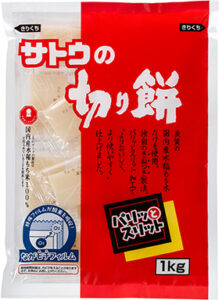
Kirimochi is pounded glutinous rice that has been shaped into blocks, dried at the surface and sealed individually. Fresh pounded mochi lasts a couple of days; this version lasts up to two years at room temperature because each piece is packed on its own and the moisture is locked in. Heating drives that moisture back into steam, the inside softens, and the block puffs up.
The standard square piece weighs about 50 g, so a 1 kg bag holds roughly 20 pieces. Two pieces is a normal serving for one person.
| Spec | Detail |
|---|---|
| Piece weight | About 50 g for a standard square; 20 g for mini formats |
| Best before | 24 months from manufacture for plain types |
| Storage | Room temperature, away from direct sunlight, heat and humidity |
| After opening | Refrigerate and eat quickly, regardless of the printed date |
| Packaging | Each piece sealed in its own wrapper |
| Serving | Two pieces per person is typical |
One detail worth knowing before you cook: many Japanese packs have a cross-shaped slit cut into the top and bottom of each piece. That is not decoration. Steam escapes evenly through the cuts instead of bursting out of one weak point, so the piece rises evenly rather than exploding on one side. If your pieces have no slits, expect them to blow out somewhere.
How to Cook Kirimochi
There are four methods the makers give instructions for. They produce genuinely different results, so pick by the texture you want rather than by convenience.
| Method | Time | Result | Best for |
|---|---|---|---|
| Toaster oven | 3–4 min at 1000W, then 2 min resting | Crisp browned skin, molten centre | Isobeyaki, kinako, plain |
| Frying pan with water | A few minutes, covered | Soft all through, like freshly pounded | The maker’s own recommendation |
| Microwave with water | About 2 min | Very soft, slightly wet, no crust | Speed, anko, zenzai |
| Boiling | Until it floats, then about 2 min on low | Softest, slippery | Ozoni soup |
1. Toaster Oven
Set the toaster oven and cook the mochi until the surface just begins to colour. At 1000W this takes three to four minutes. Then switch the toaster off and leave the mochi inside for about two more minutes without opening the door, so the residual heat finishes the centre.
That resting step is the part most people skip, and it is the reason mochi comes out burnt on the outside and stiff in the middle. What you are looking for is a piece that has swollen and cracked open with a pale gold surface, not a dark brown one. If your toaster’s rack has wide gaps, put a finer mesh over it first, because mochi softens and sags before it sets.
2. Frying Pan With a Little Water
Sato Foods’ own development team recommends this one over the toaster for texture. Heat the pan, put the mochi in, add a small amount of hot water, cover, and let it steam lightly. The result is soft the whole way through and closer to mochi straight from the pounding mortar than anything the toaster produces.
For a version with both textures, steam it with water first, then add butter to the pan and keep cooking until the outside crisps up.
3. Microwave
Put the mochi in a heat-resistant container and add water so the piece is covered. Heat until it has puffed up fully, which takes roughly two minutes depending on your container and wattage.
The water is not optional. The makers warn explicitly that microwaving mochi without water leaves parts of it hard or burns it, because the heating is uneven. This method gives you no crust at all, so it suits mochi that is going into sweet red bean soup or being dusted with kinako.
4. Boiling
Fill a pot with water to about twice the thickness of the mochi and lay the pieces in without stacking them. Heat until they float, moving them occasionally but not flipping them. Once the water boils, turn it down to low and simmer for about two minutes.
This is the method for ozoni, the New Year soup, and it gives the softest and most slippery result of the four.
What to Eat It With
Isobeyaki. The default. Grill the mochi, brush or dip it in soy sauce, and wrap a strip of nori around it. Salty, savoury, and the nori goes slightly crisp against the hot surface.
Kinako. Roasted soybean flour mixed with sugar and a pinch of salt. Boil or microwave the mochi so it stays soft and wet enough for the powder to stick.
Anko and zenzai. Sweet red bean paste alongside grilled mochi, or a grilled piece dropped into hot red bean soup. The contrast between the browned skin and the sweet soup is the whole point.
Ozoni. The New Year soup, built on dashi with mochi and vegetables. The broth and the ingredients change completely from region to region, which is one of the standing arguments in Japanese households.
Butter and soy sauce. Pan-fry in butter, finish with soy sauce. Not traditional, universally liked.
Cheese and savoury bakes. Sato Foods lists gratin and pizza as intended uses for its slit mochi, since the pieces break apart by hand along the cuts. Melted cheese over mochi behaves a little like a very chewy potato.
Order Japanese Mochi Worldwide
Room-temperature products, shipped with tracking in about 7 to 14 days. Duties shown at checkout, before you pay.
Shop on kachicollectThe Kirimochi You Won’t Find Outside Japan
What reaches overseas shelves is the plain white square in a large bag. That is one product out of a category that runs to more than thirty in Japan, across two of the main makers alone. The differences are in shape, in the rice itself, and in what gets pounded into the dough.
Shapes and Formats
The square block is the default, but it is far from the only option, and the shape changes what you can cook.
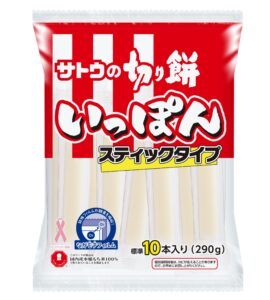
Stick mochi. Sold as ten sticks in a 290 g pack, shaped to be rolled in a nori sheet or wrapped in bacon rather than cut. A different eating format rather than a different flavour.
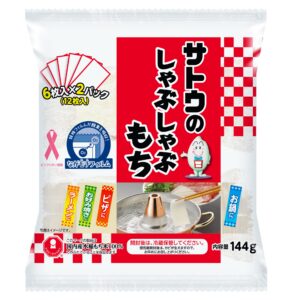
Shabu-shabu mochi. Paper-thin mochi sheets, 144 g in two 72 g portions, made to be swirled through hotpot broth for a few seconds. They soften almost instantly, which a 50 g block cannot do.
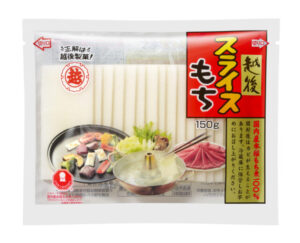
Sliced mochi. Echigo Seika’s 150 g sliced format, thin enough to lay on toast or across a gratin dish so it melts evenly instead of sitting as a lump.
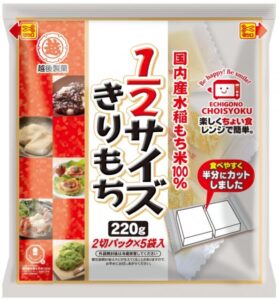
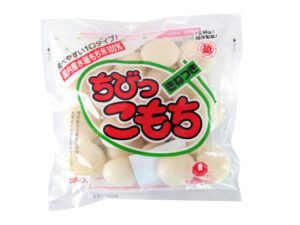
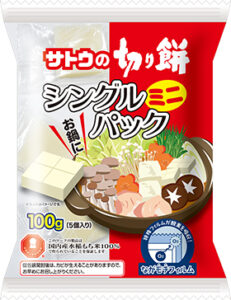
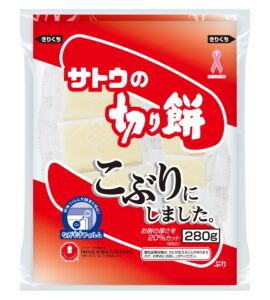
Half-size and small pieces. Half-size kirimochi comes in 220 g packs, and there are smaller formats aimed at children, along with 20 g mini pieces sold five to a pack. Smaller pieces are also the ones to choose if anyone at the table has trouble chewing.
The Rice Itself
Plain kirimochi does not name its rice. The premium line does, and the cultivar is the entire selling point.
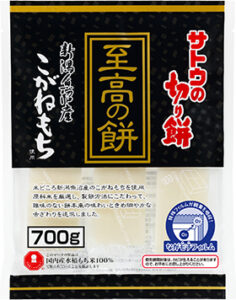
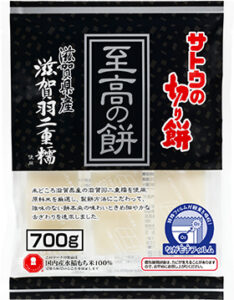
Uonuma Koganemochi. Koganemochi glutinous rice grown in Uonuma, Niigata, the region best known in Japan for rice. Sold in 300 g and 700 g packs rather than the bulk bag.
Shiga Habutai. Habutaimochi glutinous rice from Shiga prefecture, the other named cultivar in the premium range, also in 300 g and 700 g.
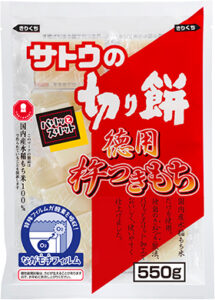
Kine-tsuki. Not a rice but a method: pounded with a pestle rather than extruded. Sold as a value pack in 550 g, 800 g and 1.1 kg.
Flavoured Mochi
This is the group with no export equivalent at all. Shelf life drops to about nine months because the additions are real ingredients rather than flavouring.
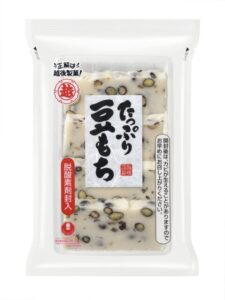
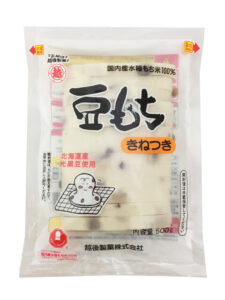
Mame mochi. Hokkaido black soybeans pounded into the mochi, so the pieces are studded with whole beans. Grilled slowly over low heat, it is savoury and nutty rather than sweet. Sold as 220 g four-piece packs and 500 g bags.
Yomogi mochi. Japanese mugwort pounded through the dough. Echigo Seika uses a high-pressure treatment on the mugwort specifically to keep the colour bright, and sells it as a 450 g pack and as 220 g four-piece packs.
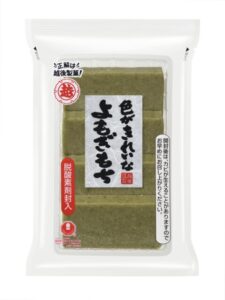
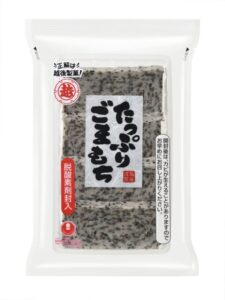
Goma mochi. Sesame seeds throughout, in the same 220 g four-piece format. Nuttier than mame mochi and it toasts faster.
Mochi Made for One Job
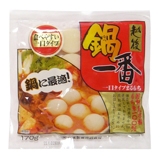
Hotpot mochi. A 170 g pack sized and shaped for dropping into nabe.
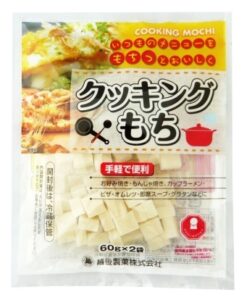
Cooking mochi. 120 g in two 60 g bags, portioned for recipes rather than for eating as a piece.
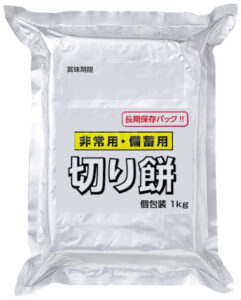
Emergency stockpile mochi. A 1 kg pack with a five-year shelf life, sold for disaster stockpiling. Mochi is dense in calories and needs only hot water, which is why it sits in Japanese emergency supplies next to bottled water and instant rice.
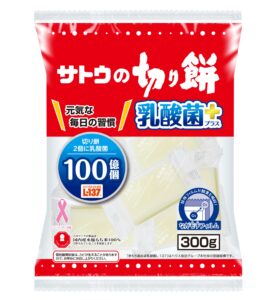
Mochi with lactic acid bacteria. A 300 g pack with added lactic acid bacteria, which is the kind of functional-food variant that tends not to leave the Japanese market.
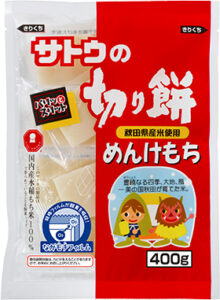
Regional names. Menke mochi and Takayama mochi are sold under their own names in 400 g, 1 kg and 800 g packs, aimed at particular regional markets inside Japan.
How to Get Them
Order From the kachicollect Catalog
kachicollect is a Japan-based shop carrying only products made for the Japanese market. You pay the listed price plus shipping with no proxy fees, and the total including duties is shown at checkout before you pay. Payment is in your local currency by Visa, Mastercard or JCB, so you do not need a Japanese address or card, and orders ship worldwide with tracking in about 7 to 14 days.
Request a Specific Type by URL
The formats on this page are the practical reason to use the request function. Stick mochi, shabu-shabu sheets, mame mochi, yomogi mochi, the named-cultivar packs — these do not travel into export channels, so they will not appear on an overseas shelf no matter how long you wait.
Send us the product link from a Japanese site and you will get an instant quote, then buy it directly on kachicollect with no service fees. That covers Japanese marketplace listings in general. If you want the flavoured types, note the shorter nine-month shelf life and order what you will actually get through.
Before You Eat It: A Safety Note
Mochi is a genuine choking hazard, and Japan treats it as one. The Consumer Affairs Agency publishes a warning every year before the New Year holiday, because 43% of elderly deaths from mochi choking happen in January and another 14% in December.
Their advice is straightforward and worth following whatever your age:
Cut it small. Cut each piece into a size you can manage comfortably rather than eating a 50 g block in two bites. This is also why the half-size and children’s formats exist.
Take small mouthfuls. One piece at a time, not a mouthful you have to work at.
Moisten your throat first. Have tea or soup before you start eating.
Chew slowly and fully before swallowing. Mochi does not break down the way bread does.
Watch over older people and young children while they eat. Someone else being present is the single factor that changes the outcome.
Frequently Asked Questions
How long does kirimochi last?
Plain types carry a best-before date 24 months from manufacture, stored at room temperature away from sunlight, heat and humidity. Flavoured types such as mame, yomogi and goma are about nine months. There is also a stockpiling version rated for five years.
What do I do once the bag is open?
The individual pieces stay sealed, but the makers advise refrigerating an opened bag and eating it quickly regardless of the printed date, because mould forms more easily after opening.
Can I eat mochi that has mould on it?
No. The makers are explicit: never eat mochi with mould on it, and do not simply cut the mouldy part off. The mould can have spread through the inside, and the toxins are not destroyed by heating.
Why did my mochi burn on the outside and stay hard inside?
Almost always the resting step. Cook until the surface only starts to colour, then turn the heat off and leave the mochi in the closed toaster for about two more minutes. Microwaving without water causes the same problem.
How many pieces is one serving?
Two standard 50 g pieces per person is typical, so a 1 kg bag of roughly 20 pieces feeds about ten servings.
Conclusion
Four methods, and the one that matters most is the two minutes you leave it alone after the heat goes off. Toaster for a crisp shell, frying pan with a splash of water for the softest result, microwave for speed, boiling for soup.
Once you are past the cooking, the interesting part is the range. Stick mochi for rolling in nori, paper-thin sheets for hotpot, slices for toast, black soybean and mugwort and sesame, named cultivars from Uonuma and Shiga, and a five-year emergency pack. None of that reaches an overseas shelf. The kachicollect catalog already carries a wide selection of Japan-only items you can order directly, and anything not listed can be requested by sending the product link. You pay the item price plus shipping with no proxy fees, see the total including duties before checkout, and first-time customers can use the code WELCOME20 for 20% off. If you want mochi you can eat straight from the bag with no cooking at all, see our guide to Japanese mochi snack flavours. And if you are still untangling daifuku from dango, start with the different types of Japanese mochi.
Order Kirimochi From Japan
Products made for the Japanese market, shipped worldwide with tracking in about 7 to 14 days. Use code WELCOME20 for 20% off your first order.
Shop Now at kachicollect