There is no single best Japanese matcha, because the powders sold under that name are built for different jobs. Recommending a tin of ceremonial-tier drinking matcha to someone who wants an iced latte is a bad recommendation, however good the matcha is.
So this guide picks by purpose rather than ranking one to ten. It also does two things most matcha round-ups avoid: it tells you what each tier actually costs relative to the others, and it names the products you should not buy yet if you are new.
Japanese Tea, Direct From Japan
kachicollect only carries products made for the Japanese market. No proxy fees, and duties are shown before you pay.
Shop on kachicollectHow These Were Chosen
Everything here is selected from published specifications, not from taste rankings. Specifically:
Where matcha sits in the ingredient list. Japanese labelling law requires ingredients in descending order by weight, so the position of matcha is the one hard number you get on a sweetened mix.
Whether the origin is named. A label that says matcha from a specific prefecture is making a commitment that a label saying only “matcha” is not.
What the maker says it is for. Japanese producers separate their range by intended use — thin tea, thick tea, confectionery — and that classification is more useful than any imported grading vocabulary.
Format and price per gram. Sticks, bags and tins suit different habits, and the cost per gram varies enormously across the categories.
One thing you will not find here is a grade. Japan has no official grading system for matcha, and no body certifies a powder as one tier or another. Our guide to Japanese matcha powder covers that in full.
The Picks at a Glance
| What you want to make | Pick | Type | Sweetness | Tool needed | Price tier | Beginner |
|---|---|---|---|---|---|---|
| A quick hot latte | Matcha latte sticks | Contains milk | Sweetened | Spoon | Low | Yes |
| Iced matcha | Matcha milk powder | Contains milk | Sweetened | Spoon | Low | Yes |
| A stronger, less milky cup | Rich koicha-style mix | Contains milk | Sweetened | Spoon | Low | Yes |
| Oat, soy or almond latte | “Just add milk” mix | No milk powder | Sweetened | Spoon | Medium | Yes |
| Baking and desserts | Unsweetened dissolving matcha | Matcha only | Unsweetened | Spoon | Medium | Yes |
| Matcha as tea, every day | Entry usucha tin | Matcha only | Unsweetened | Bamboo whisk | High | With effort |
| Thick tea, properly | Koicha tin | Matcha only | Unsweetened | Bamboo whisk | Very high | No |
Found the One You Want?
Order from the catalog, or send us the link to any Japanese product page for an instant quote. Item price plus shipping, duties shown before you pay.
Shop on kachicollectThe Picks, One by One
For a Quick Hot Latte: Matcha Latte Sticks
Milk powder and sugar are already in the stick, so hot water alone finishes the drink and there is nothing to measure. Single-serve sticks also survive a suitcase better than an opened bag, which is why this format fills airport gift shops.
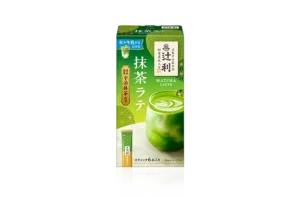
The well-known example is the Starbucks Premium Mix matcha latte made for the Japanese market by Nestlé Japan, in 24 g sticks at roughly 103 kcal each. Nestlé describes it as a distinctly Japanese flavour popular with visitors, and it is not part of the global Starbucks range.
For Iced Matcha: Matcha Milk Powder
The thing to check is not the flavour but the solubility. Some Japanese powders state on the pack that they dissolve in cold water and cold milk; others only work hot. Buy the wrong one and you will be chasing lumps around a cold glass.
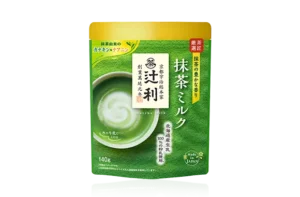
The example above is built on milk powder made from Hokkaido milk and says plainly that it dissolves cold. Its ingredient list runs sugar, glucose, creaming powder, skimmed milk powder, then matcha — matcha fifth, which is typical for this tier and perfectly reasonable for an iced sweet drink.
For a Stronger Cup: Rich Koicha-Style Mixes
Most makers offer a stronger version of their standard mix, labelled koicha-jitate or simply “rich”. These use more matcha and taste more bitter and less milky. If your first bag felt like a milkshake, this is the correction, and it costs about the same.
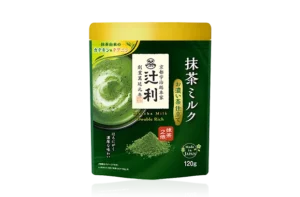
A rich Kyoto Uji matcha latte we checked lists sugar, whole milk powder, then tea (matcha) from Kyoto Prefecture in third place, with the origin named. That combination — matcha third and a named prefecture — is the strongest signal available on a sweetened mix.
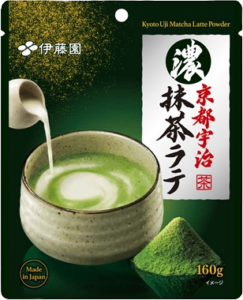
For Oat, Soy or Almond Milk: “Just Add Milk” Mixes
These contain no milk powder at all. One Uji matcha version is made from matcha, sugar and wasanbon sugar and nothing else, which is the shortest ingredient list in this guide. Because you supply the liquid, any plant milk works and you control the strength.
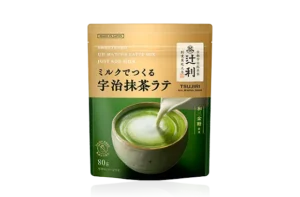
This is also the pick if you simply want fewer additives. Compare it with the creaming powder, casein, emulsifier and stabiliser in a standard matcha milk and the difference is obvious on the label.
For Baking and Desserts: Unsweetened Dissolving Matcha
Do not bake with a latte mix. It is mostly sugar and milk solids, so it will unbalance a recipe and mute the colour. What you want is unsweetened matcha processed to disperse without a whisk, which works in cakes, ice cream, whipped cream and glazes, and also makes a plain drink if you want one.
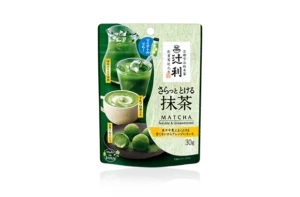
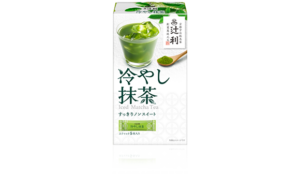
There are unsweetened stick formats too, sold for cold matcha, which give you a measured dose with no sugar attached.
For Matcha as Tea: An Entry Usucha Tin
This is the first genuine drinking matcha on the list, and the first that needs a bamboo whisk. Look for one the maker positions for everyday and practice use rather than for its top shelf.
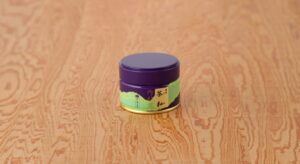
A good example from Nishio in Aichi is described by its maker as close to green tea in character, suited to everyday drinking, tea practice, and cooking, with a refined astringency that holds up when mixed with milk and sugar. It comes as a 20 g tin, a 40 g tin and a 100 g bag, so you can start small.
That versatility is the point. An entry usucha is the one tin that works whisked, in a home latte, and in a cake, which makes it the sensible first purchase if you are moving beyond mixes.
For Thick Tea: A Koicha Tin
Koicha is not a stronger usucha. It is kneaded rather than whisked to a foam, using several times the powder in much less water, and it demands leaf good enough that concentration does not turn harsh.
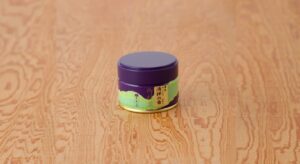
Even a maker’s most affordable koicha, positioned for everyday and practice use within that category, costs several times an entry usucha per gram. Makers name these with the suffix mukashi, and a tin carrying that name is telling you which side of the line it sits on.
This is a real product for people who want it. It is also the one we would tell a beginner to leave until later, for reasons in the last section.
What Matcha Actually Costs
Because there are no grades, price is doing a lot of the signalling, and the spread across these categories is much wider than people expect. Taking the cheapest category as a baseline of one, here is roughly how the cost per gram compares.
| Category | Relative cost per gram | What you get |
|---|---|---|
| Matcha latte powder | ×1 | Mostly sugar and milk solids |
| “Just add milk” mix | ≈ ×2.6 | Matcha and sugar only |
| Unsweetened dissolving matcha | ≈ ×4.7 | Matcha, processed to dissolve |
| Entry usucha tin | ≈ ×17 | Drinking matcha, everyday tier |
| Entry koicha tin | ≈ ×47 | Thick-tea tier |
These are ratios drawn from Japanese makers’ own published sizes and list prices at the time of writing in September 2026, not a price you will pay anywhere in particular. They are here to show the shape of the market: the gap between a latte powder and a koicha tin is not a matter of a little more money, it is roughly fiftyfold per gram.
Why the top of the range costs what it does. Drinking matcha is made only from the spring harvest, the finest is picked by hand, and grinding is the bottleneck — a stone mill turns out about 40 g an hour. Larger tins and bags lower the cost per gram somewhat, which is why a 100 g bag of the same product is cheaper per gram than a 20 g tin.
Prices are moving right now. Japan has been in a matcha shortage since autumn 2024, and it has reached the shelf. At the first tencha auction of 2026 in Kyoto, the average winning price per kilogram hit a ten-year high. Established tea houses have introduced purchase limits, and the shop pages of individual matcha now carry notes like “maximum five per customer”, “one matcha item per customer” and “restock date undetermined”. Several tins have shifted to made-to-order with a lead time.
The practical consequences for you: buy the tin you want when you see it, expect the price you remember to be out of date, and treat availability rather than price as the binding constraint on drinking matcha.
Matcha Is Hard to Get Right Now
Send us the link to the tin you want and you will get an instant quote. No proxy fees, duties shown at checkout, tracked delivery in about 7 to 14 days.
Shop on kachicollectWhat to Skip if You’re New
Being told what not to buy is more useful than another recommendation. These are the four purchases we would talk a beginner out of.
Koicha-Grade Matcha
It is the most expensive thing on the shelf and the least forgiving. Koicha is made by kneading a large quantity of powder into a small amount of water, and if you whisk it as a normal bowl of thin tea you get something intensely bitter that wastes what you paid for. The qualities you are paying for only appear in the preparation it was made for.
Buy instead: an entry usucha tin. If you later want koicha, you will know, and you will have learned to whisk on something cheaper.
Any Pure Matcha, If You Don’t Have a Whisk
Matcha does not dissolve. It suspends, and then it settles. A spoon leaves powder sitting at the bottom of the bowl and clumps floating on top, which is not a defect in the matcha. A bamboo whisk exists because the job needs one.
Buy instead: either add a whisk to the order, or choose an unsweetened matcha specifically processed to dissolve, which is made for exactly this situation.
The Top of the Price Range
The difference between a mid-tier and a top-tier tin is real, and it is also subtle, and it lands on a palate that has had practice. Spending heavily on your first tin mostly buys you an expensive way to find out you cannot taste the difference yet.
Buy instead: the smallest tin of an everyday-tier matcha. Most makers sell 20 g precisely so you can try without committing.
Anything Sold to You on Its Grade
Japan does not have a matcha grading system. There is no certifying body and no legal definition behind tier names used in English, so a label describing a powder’s grade is describing a marketing decision, not a standard.
Look for instead: a named growing region, the maker’s own stated use, and the position of matcha in the ingredient list. Those three are verifiable.
How to Buy
Order From the kachicollect Catalog
kachicollect is a Japan-based shop carrying only products made for the Japanese market, including Japanese tea. You pay the listed price plus shipping with no proxy fees, and the total including duties is shown at checkout before you pay. Payment is in your local currency by Visa, Mastercard or JCB, so you do not need a Japanese address or card, and orders ship worldwide with tracking in about 7 to 14 days.
Request a Specific Tin by URL
Matcha is the category where this matters most. Individual tins go out of stock, shift to made-to-order, or carry per-customer limits, and the range that reaches overseas shelves is a fraction of what exists. Send us the product link from a Japanese site and you will get an instant quote, then buy it directly on kachicollect with no service fees.
Frequently Asked Questions
What is the best Japanese matcha overall?
There isn’t one, and any guide that names a single winner is ignoring what you plan to make. For drinking as tea, an everyday-tier usucha tin is the best starting point. For lattes, a sweetened mix with matcha high in the ingredient list. For baking, unsweetened matcha. These are not rankable against each other.
Is expensive matcha actually better?
The raw material genuinely differs, and so does the price per gram — around fiftyfold between a latte powder and a koicha tin. Whether the difference is worth it to you depends on how you prepare it and how much practice your palate has had. In a sweetened iced latte, most of what you paid for is not detectable.
How much should a beginner spend?
Start with a 20 g tin of an everyday-tier drinking matcha, which is the size Japanese makers offer for exactly this purpose, and a bamboo whisk. If you only want lattes, a bag of sweetened mix costs a fraction of that and is the right answer.
Is Uji matcha the best?
Uji is a growing region with a strong reputation, not a quality rating, and excellent matcha is produced in several parts of Japan — Nishio in Aichi and Kagoshima among them. A named origin tells you the maker is willing to commit to one; it does not by itself rank the powder.
Is matcha really in short supply?
Yes, and it is visible in the retail channel. Purchase limits per customer, tins moved to made-to-order, and undetermined restock dates all appear on Japanese shop pages at the time of writing, and the 2026 raw-leaf auction price in Kyoto set a ten-year high.
How should I store it?
Sealed, away from sunlight, heat and humidity, and refrigerated in hot weather. Matcha takes on surrounding smells quickly, so an airtight container matters more than the printed date. Colour and aroma fade before anything else does, so open tins are best finished well ahead of the date.
Conclusion
Decide what you are making before you decide what to buy. Lattes want a sweetened mix, and the useful comparison between them is where matcha appears in the ingredient list. Baking wants unsweetened powder. Tea wants an everyday usucha tin and a whisk, and koicha can wait until you want it. The gap between the bottom and top of that list is roughly fiftyfold per gram, so choosing by purpose is also the way to avoid overpaying.
The kachicollect catalog carries Japanese tea alongside a wide selection of other Japan-only products you can order directly, and anything not listed can be requested by sending the product link — which is the practical route while supply is tight. You pay the item price plus shipping with no proxy fees, see the total including duties before checkout, and first-time customers can use the code WELCOME20 for 20% off.
Order Japanese Matcha From Japan
Products made for the Japanese market, shipped worldwide with tracking in about 7 to 14 days. Use code WELCOME20 for 20% off your first order.
Shop Now at kachicollect