Organic, additive-free and unsweetened get used almost interchangeably in matcha marketing, and they are three different claims about three different things. A matcha can be certified organic and still be full of sugar. It can be unsweetened and not organic. It can say “no additives” and mean something narrower than you assume.
In Japan all three are regulated, and two of them are regulated tightly enough that the wording on the pack is genuinely informative. Here is what each one means, how to check it, and which products actually carry them.
Japanese Tea, Direct From Japan
kachicollect only carries products made for the Japanese market. No proxy fees, and duties are shown before you pay.
Shop on kachicollectThree Claims That Are Not the Same Thing
| Claim | What it is about | What governs it in Japan | What it does not tell you |
|---|---|---|---|
| Organic | How the tea was grown | The Organic JAS certification system | Whether sugar or additives were added later |
| Additive-free | What was put in during manufacture | Consumer Affairs Agency guidelines, in force since April 2024 | How the tea was farmed |
| Unsweetened | Sugar content | The Food Labelling Standards | Anything about farming or additives |
These axes are independent. The practical consequence is that you have to decide which one you actually care about, because a product that satisfies one may not satisfy the others.
What “Organic” Legally Means in Japan
This is the strictest of the three, and the one where Japanese labelling is more reliable than in many markets. In Japan the words “organic” and its Japanese equivalent are not a voluntary marketing claim. To use them on food, the producer must be certified by a registered certification body accredited by the Minister of Agriculture, Forestry and Fisheries.
For tea, which is a perennial crop, the requirement is that no synthetic pesticides or chemical fertilisers have been used on the field, with at least three years elapsed between the start of conversion and the first harvest sold as organic. The visible marker is the Organic JAS mark on the pack, and only certified operators may apply it.
Two things follow from this. First, a Japanese matcha carrying that mark has passed a third-party audit, not a self-declaration. Second, organic matcha is scarcer and slower to produce than conventional matcha, which is why the range is small and the prices are higher — a point the products below illustrate.
What “Additive-Free” Means Since April 2024
This one changed recently, and in the buyer’s favour. Japan’s Consumer Affairs Agency published guidelines on additive-free labelling in March 2022, and they came into full force in April 2024. The guidelines identify ten categories of wording that manufacturers must be careful with, including simply writing “no additives” with nothing further, and combining “no additives” or “not used” with words like artificial, synthetic, chemical or natural.
The practical effect is that a Japanese pack claiming to be additive-free today is making a narrower and better-supported claim than the same wording would have carried a few years ago. Where a maker states specifically what has been left out — no flavouring, no artificial sweetener, no emulsifier — that specificity is itself a signal, because the guidelines discourage vague blanket claims.
It is worth knowing what this claim does not cover. Additive-free says nothing about how the tea was farmed, and nothing about sugar, which is a food rather than an additive.
What “Unsweetened” Means
Sugar wording in Japan falls under the Food Labelling Standards, and two phrases that sound alike are governed differently.
“Unsweetened” and “sugarless” are claims about how much sugar the product contains, and are held to the standard for claims that a product does not contain a nutrient.
“No sugar added” is a different kind of claim, governed as a no-addition claim. It means sugar was not added during manufacture, which is not the same as the product containing no sugars — sugars can be present from other ingredients.
“Reduced sugar” and similar wording has a numeric threshold: under 5 g per 100 g for foods and under 2.5 g per 100 ml for drinks.
So if you are avoiding sugar entirely, look for the unsweetened wording rather than the no-sugar-added wording, and check the nutrition panel.
Looking for a Specific Certification?
Send us the link to any Japanese product page for an instant quote. No proxy fees, duties shown before you pay.
Shop on kachicollectThe Products
| Product | Maker | Organic | Additive-free | Unsweetened | Format | Availability |
|---|---|---|---|---|---|---|
| Organic Matcha | Ippodo | Certified | Matcha only | Yes | 20 g box | In stock |
| Kaze-no-kaori organic matcha | Aiya | Certified | Matcha only | Yes | 30 g tin / 100 g bag | Made to order |
| Mori-no-utage organic matcha | Aiya | Certified | Matcha only | Yes | 30 g tin / 100 g bag | Made to order |
| Ten-no-midori organic matcha | Aiya | Certified | Matcha only | Yes | 30 g tin / 100 g bag | Made to order |
| Additive-free matcha latte | Ito En | No | Stated | No | 180 g bag | Retail |
| Unsweetened rich matcha latte | Ito En | No | — | Yes | 140 g bag | Retail |
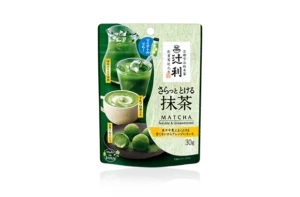
| Quick-dissolving matcha | Tsujiri | No | Matcha only | Yes | 30 g bag | Retail |
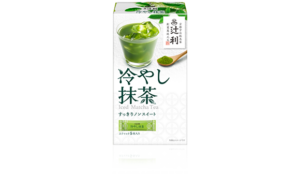
| Chilled matcha sticks | Tsujiri | No | Matcha only | Yes | 5 sticks | Retail |
| Plain drinking matcha tins | Various | Varies | Matcha only | Yes | 20–30 g tins | Limited |
Certified Organic
The organic range in Japanese matcha is genuinely small, and most of it sits at the drinking-matcha end rather than in latte mixes.
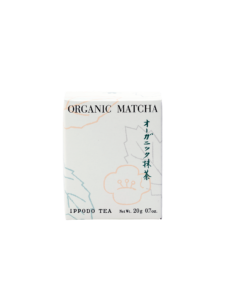
A Kyoto tea house sells a certified organic matcha in a 20 g box, described by the maker as having a powerful natural fragrance with a light, cleanly sharp finish, and suggested for lattes as well as for whisking. It is the most accessible entry point here because it is in stock and in the smallest size.
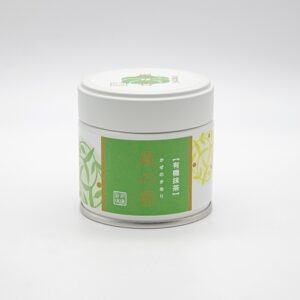
A maker in Nishio, Aichi offers three certified organic matchas at ascending grades, all made without chemical fertilisers or pesticides, each available as a 30 g tin or a 100 g bag.
Kaze-no-kaori is the lightest of the three, described as fresh and clean with a floral note, and the maker specifically recommends it for cooking as well as whisking, noting that its bright astringency brings matcha flavour forward in a recipe.
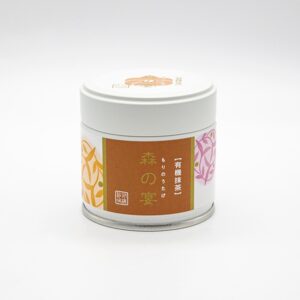
Mori-no-utage sits in the middle, with the maker describing a balance between umami and astringency.
Ten-no-midori is the richest, described as mellow and deep with a sweet aroma.
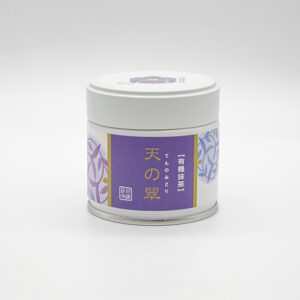
All three are made to order, with the maker stating that delivery can take up to two weeks. That is worth planning around, and it is also a useful signal: organic matcha is produced in small quantities, not held in bulk.
Additive-Free
Ito En sells a matcha latte powder stated to contain no flavouring, no artificial sweetener and no emulsifier, made with two different matchas. That specificity is exactly the kind of claim the 2024 guidelines favour over a bare “additive-free” banner.
It is a sweetened product, so it answers the additive question and not the sugar one. For context on what a standard latte powder contains, several products in this category list creaming powder, casein, pH adjusters, stabilisers such as CMC and emulsifiers, and two we checked use aspartame and acesulfame K.
Unsweetened
Two routes here. The first is an unsweetened latte powder: Ito En sells a rich version with no sugar added, so you control the sweetness yourself while keeping the convenience of a mix.
The second is unsweetened matcha processed to dissolve. It has no sugar and no milk, disperses in water or milk without a whisk, and unlike a sweetened mix it also works in baking.
There are unsweetened stick formats too, sold for cold matcha, which give a measured dose with nothing added.
Nothing Added at All
The category most people overlook when searching for clean-label matcha is plain drinking matcha. A tin of matcha contains matcha. No sugar, no milk solids, no emulsifier, nothing to read past the first line of the ingredient list — whether or not it carries an organic certification.
If your objection is to additives and sugar rather than to conventional farming specifically, an ordinary tin of drinking matcha already satisfies it, usually at a lower price than the certified organic equivalent. Our guides to the best Japanese matcha by purpose and Kyoto Uji matcha cover that range.
Order Japanese Matcha Worldwide
Powder is light and shelf-stable. Duties shown at checkout, tracked delivery in about 7 to 14 days.
Shop on kachicollectHow to Check It Yourself
Look for the certification mark, not the word. On a Japanese pack, organic status is carried by the Organic JAS mark. A product using the word without the mark is not certified under the Japanese system.
Read what specifically was left out. Since April 2024, vague additive-free banners are discouraged. A maker that names the omissions — no flavouring, no artificial sweetener, no emulsifier — is telling you more than one that just says “additive-free”.
Distinguish unsweetened from no-sugar-added. They are different claims under different standards. If sugar is the thing you are avoiding, the unsweetened wording is the one to look for.
Check the whole ingredient list, not the front. The shortest list in Japanese matcha is one word. Anything longer tells you what kind of product you are actually holding.
Plan for lead times. Organic matcha is often made to order. Two weeks before dispatch is normal, and that is before international shipping.
How to Buy
Order From the kachicollect Catalog
kachicollect is a Japan-based shop carrying only products made for the Japanese market, including Japanese tea. You pay the listed price plus shipping with no proxy fees, and the total including duties is shown at checkout before you pay. Payment is in your local currency by Visa, Mastercard or JCB, so you do not need a Japanese address or card, and orders ship worldwide with tracking in about 7 to 14 days.
Request a Specific Product by URL
This matters more in this category than most, because the certified organic range is small, often made to order, and almost never exported. Send us the product link from a Japanese site and you will get an instant quote, then buy it directly on kachicollect with no service fees.
Frequently Asked Questions
Is Organic JAS the same as pesticide-free?
Not quite. Organic JAS certification requires that prohibited synthetic pesticides and chemical fertilisers have not been used, verified by an accredited certification body over a set conversion period — three years for a perennial crop like tea. A claim of being pesticide-free made outside that system has no third-party verification behind it.
Does organic matcha taste different?
Makers describe their organic matchas in the same vocabulary they use for the rest of their range — fresh and floral, balanced, mellow and deep — rather than as a separate flavour category. Choose by the described profile and intended use, the same way you would choose a conventional tin.
Does “additive-free” mean the product is healthier?
It means specific additives were not used, which is a factual statement about manufacture rather than a health claim. A sweetened additive-free latte powder still contains sugar and milk solids.
Is plain matcha additive-free?
Plain drinking matcha is ground tea leaf and nothing else, so yes in practice. Makers rarely advertise it that way because there is nothing to advertise — it is simply what matcha is.
Why is organic matcha more expensive?
Certification requires a multi-year conversion period and ongoing audits, yields are generally lower without synthetic inputs, and the volumes produced are small. Several products in this category are made to order rather than stocked, which reflects how little of it exists.
How should I store it?
Sealed, cool, away from light and humidity, and refrigerated in hot weather. Drinking matcha is often dated at two to three months, so buy the size you will finish rather than the size that looks like better value.
Conclusion
Decide which of the three claims you actually want before you shop. If it is farming, look for the Organic JAS mark and expect a small range, higher prices and lead times. If it is additives, look for a maker that names what it left out, and note that the rules behind those claims got stricter in April 2024. If it is sugar, look for unsweetened rather than no-sugar-added.
And if what you want is simply matcha with nothing in it, a plain tin of drinking matcha already is that, and it is the cheapest way to get there.
The kachicollect catalog carries Japanese tea alongside a wide selection of other Japan-only products, and anything not listed can be requested by sending the product link. You pay the item price plus shipping with no proxy fees, see the total including duties before checkout, and first-time customers can use the code WELCOME20 for 20% off.
Order Organic Matcha From Japan
Products made for the Japanese market, shipped worldwide with tracking in about 7 to 14 days. Use code WELCOME20 for 20% off your first order.
Shop Now at kachicollect