Mochi is a Japanese rice cake made by steaming glutinous rice and pounding it until the grains disappear into one smooth, stretchy, sticky mass. It tastes of very little on its own, a mild rice sweetness, and the whole point is the texture: soft and elastic when fresh, crisp outside and molten inside when grilled.
That is the short answer. The longer one is that mochi is also one of the most symbolically loaded foods in Japan, tied to New Year, the gods and almost every celebration on the calendar. Below is what it is made of, how it is made, what it tastes like, what it means, and where it came from.
Try Real Japanese Mochi
kachicollect only carries products made for the Japanese market. No proxy fees, and duties are shown before you pay.
Shop on kachicollectThe Short Answer
| Question | Answer |
|---|---|
| What it is | Steamed and pounded glutinous rice |
| Main ingredient | Mochigome (glutinous rice), nothing else in plain mochi |
| Texture | Soft, stretchy and sticky when fresh or heated; hardens as it cools |
| Taste | Mild, faintly sweet rice; flavour comes from what you eat it with |
| Sweet or savoury | Both: soy sauce and nori, or kinako and red bean paste |
| When it is eaten | All year, but above all at New Year and on festival days |
| Gluten | None, despite the name “glutinous” |
What Mochi Is Made Of
Mochigome (Glutinous Rice)
Mochi is made from mochigome, a short-grain rice that turns sticky when cooked. The difference is in the starch. Ordinary Japanese rice (uruchi) is roughly 80% amylopectin and 20% amylose, while mochigome is almost 100% amylopectin, and amylopectin is what makes cooked rice cling together and stretch.
“Glutinous” refers to that glue-like stickiness, not to gluten. Plain mochi contains no wheat and no gluten, although flavoured products can contain other ingredients, so check the label.
Pounded Rice vs Rice Flour
Mochi in the strict sense is made from whole grains that are steamed and pounded. A second family of Japanese sweets is made from rice flour instead: shiratamako, made from mochigome, gives shiratama dumplings and the soft skin of many daifuku, while joshinko, made from ordinary rice, gives firmer dango. They are related but not the same, and our guide to the different types of Japanese mochi sorts them out one by one.
How Mochi Is Made
Mochitsuki: Pounding by Hand
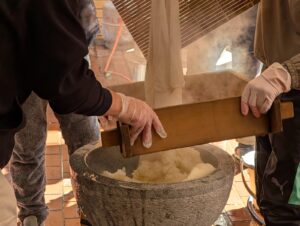
The traditional method is called mochitsuki. The mochigome is soaked, steamed, and then pounded in a large wooden or stone mortar called an usu with a heavy wooden mallet called a kine. Usually one person swings the mallet while another turns and wets the mass between strikes, and the rhythm between the two is what people remember about it.
Once smooth, the mochi is either pinched off and rolled into rounds, or spread flat and cut into squares when it has firmed up. Mochitsuki is still a year-end event in many neighbourhoods, schools and shrines, even though most households no longer pound their own.

At Home and in Factories
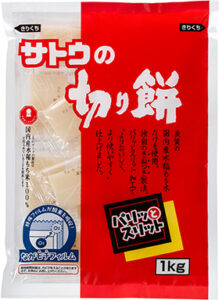
Today most mochi in Japan is either made in a home mochi machine, which steams and kneads the rice in one appliance, or bought ready-made. The most common shop-bought form is kirimochi: hard, individually sealed blocks that keep for months at room temperature and soften when heated. Our guide to how to cook kirimochi covers the four standard ways to heat them.
What Mochi Tastes Like
Plain mochi tastes of lightly sweet rice and not much else. Eating it is mostly about texture, and that changes a lot with its state. Freshly pounded, it is soft and pillowy; grilled, it puffs up with a crisp, blistered crust around a molten, stretchy centre; left out, it firms up within hours and turns hard.
That hardening is the starch retrograding as it cools and loses water, which is why fresh mochi has to be eaten within a day or two and why packaged mochi is sold hard and meant to be reheated. Because the flavour is so neutral, mochi takes on whatever it is paired with.
| Topping or dish | What it is | Taste |
|---|---|---|
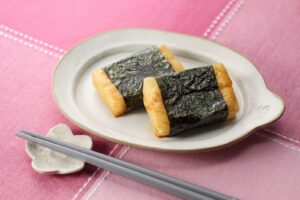
| Isobeyaki | Grilled mochi dipped in soy sauce and wrapped in nori | Salty, savoury |
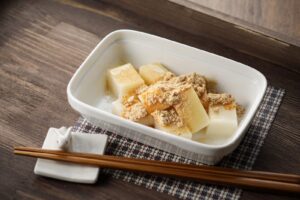
| Kinako mochi | Mochi rolled in roasted soybean flour and sugar | Nutty, sweet |
| Anko | Mochi with sweet red bean paste | Sweet |
| Oroshi mochi | Mochi with grated daikon and soy sauce | Fresh, savoury |
| Ozoni | Mochi in a New Year soup | Depends on region |
| Oshiruko / zenzai | Mochi in sweet red bean soup | Sweet, warming |
What Mochi Means in Japan
In Japan, mochi is food for hare no hi, the special days that break up ordinary life. Rice was believed to hold the spirit of the rice deity, and pounding it into mochi concentrated that into something fit to offer the gods. Mochi was treated as something a god could dwell in, which is why it sits on altars and appears at almost every point where the year or a life turns a corner.
New Year: Kagami Mochi and Ozoni
Kagami mochi is the New Year decoration of two round mochi stacked one on top of the other, usually topped with a daidai, a bitter orange. “Kagami” means mirror: the shape is modelled on the round bronze mirrors used in ancient ritual, and the two tiers are said to stand for the sun and the moon. The name daidai sounds like the word for “generation after generation”, a wish for the family to continue.
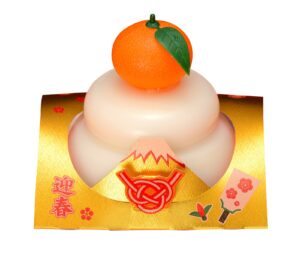
In many areas it stays on display until kagami biraki, usually on 11 January, when it is broken up and eaten. The date varies by region. No knife is used, since pointing a blade at an offering to the gods is considered bad luck; the mochi is cracked with a wooden mallet instead, and even the word “break” is avoided in favour of biraki, “opening”.
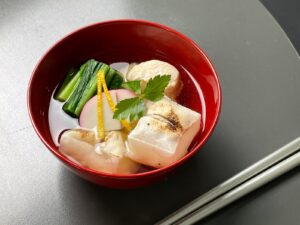
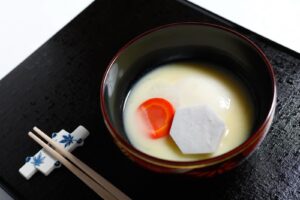
Ozoni is the New Year soup with mochi in it, and it is one of the clearest regional divides in Japanese food. East of the Sekigahara line, the mochi is usually square and grilled; to the west, it is round and simmered. Tokyo-style ozoni has a clear soy-sauce broth, Kyoto’s is made with white miso, and parts of the San’in region on the Sea of Japan coast use a sweet red bean soup instead.
Seasonal Festivals
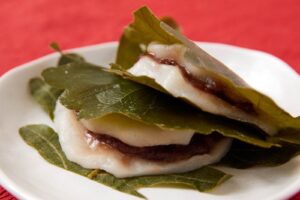
Kashiwa mochi, mochi filled with red bean paste and wrapped in an oak leaf, is eaten on Children’s Day on 5 May. Oak trees do not drop their old leaves until the new buds have grown, so the leaf stands for the family line continuing unbroken. For Hinamatsuri, the girls’ festival on 3 March, families display hishimochi, a diamond-shaped stack of green, white and pink layers, often explained as health, purity and warding off evil.
Celebrations
Red-and-white mochi (kohaku mochi) appear at weddings, births and other celebrations, since red and white are Japan’s colours of good fortune. In some regions, when the frame of a new house goes up, the owners throw mochi to neighbours from the roof in a custom called mochimaki, sharing the good luck of the new building.
Have Your Own New Year Mochi
Kirimochi, mochi snacks and Japan-only sweets, shipped worldwide with tracking. Duties shown before checkout.
Browse kachicollectA Short History of Mochi
Mochi goes back at least to the Nara period. The Bungo no Kuni Fudoki, an 8th-century provincial record, tells of a wealthy man who used a mochi as an archery target, only for it to turn into a white bird and fly away, after which his fields failed. The story is a warning against disrespecting rice, and it shows mochi was already understood as something more than food.
In the Heian period, the imperial court marked New Year with hagatame, a ceremony of eating hard foods to wish for long life, and mochi was part of it. The Tale of Genji mentions both the hagatame celebration and a mirror mochi, and the custom of displaying kagami mochi took on its familiar form from around the Muromachi period.
For a long time, mochi was mainly for rituals and the upper classes. By the Edo period, New Year mochi and ozoni had spread to ordinary households, and square cut mochi appeared in eastern Japan, which is still where square mochi dominates today.
How to Eat Mochi Safely
Mochi is a real choking hazard, especially for older people and young children, and Japan’s Consumer Affairs Agency issues a warning every year before New Year. Around 40% of elderly deaths from choking on mochi happen in January, around 20% in the first three days of the year alone.
The advice is simple: cut it into small pieces, drink tea or soup first to moisten your throat, chew slowly and thoroughly, and keep an eye on older people and children while they eat. The fuller safety note is in our kirimochi cooking guide.
Where to Try Real Japanese Mochi Outside Japan
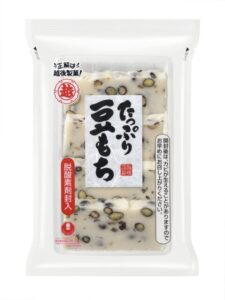
Outside Japan, “mochi” usually means mochi ice cream or a single brand of imported daifuku. The everyday mochi that Japanese households actually eat, from plain kirimochi to mochi studded with black soybeans or mixed with mugwort, and the long-life flavoured snack mochi sold as souvenirs, rarely leaves the country.
Order From the kachicollect Catalog
kachicollect is a Japan-based shop carrying only products made for the Japanese market. You pay the listed price plus shipping with no proxy fees, and the total including duties is shown at checkout before you pay. Payment is in your local currency by Visa, Mastercard or JCB, so you do not need a Japanese address or card, and orders ship worldwide with tracking in about 7 to 14 days.
Request a Specific Item by URL
If the mochi you want is not in the catalog, send the product link from a Japanese site. You get an instant quote and can buy it directly on kachicollect with no service fees, and that covers Japanese marketplace listings in general, not only shops.
Proxy services such as Buyee, ZenMarket and FROM JAPAN can also buy from Japanese sites for you, but the fee shown upfront is only the starting point and other costs are usually added along the way. They also buy at Japanese retail prices that include Japan’s 10% domestic consumption tax and pass it on to you, while kachicollect sells for export. For the same access without proxy fees, a kachicollect purchase request does the job, with the total including duties shown before you pay.
Frequently Asked Questions
Is mochi the same as a rice cake?
Mochi is usually translated as “rice cake”, but the English term also covers puffed rice cakes and other rice-based foods such as Korean tteok. In Japan, mochi specifically means glutinous rice that has been steamed and pounded.
Why is mochi eaten at New Year?
Because mochi was seen as sacred food that a god could dwell in, it became the centrepiece of the most important festival of the year. Kagami mochi is an offering to Toshigami, the deity who visits each household at New Year, and eating mochi in ozoni is a way of sharing in that blessing and wishing for a long, prosperous year.
Can you make mochi from regular rice?
Not true mochi. Ordinary rice contains around 20% amylose, which stops it becoming as smooth and stretchy when pounded. You need mochigome, or shiratamako flour made from it, for the proper texture.
How many calories are in mochi?
Plain mochi has 223 kcal per 100 g according to Japan’s official food composition tables, with about 51 g of carbohydrate and 4 g of protein. A standard 50 g kirimochi block is roughly 110 to 120 kcal.
Conclusion
Mochi is glutinous rice, steamed and pounded until it becomes one smooth, stretchy mass. It tastes of gentle rice sweetness and takes its character from soy sauce, kinako, red bean or soup. In Japan, it is also far more than a snack: it is an offering to the gods, the heart of New Year, and a thread running through festivals and celebrations for more than a thousand years.
The best way to understand it is to eat the real thing. The kachicollect catalog carries Japan-only mochi and sweets you can order directly, and anything not listed can be requested by sending the product link. You pay the item price plus shipping with no proxy fees, see the total including duties before checkout, and first-time customers can use the code WELCOME20 for 20% off. For the ready-to-eat kind, see our guide to Japanese mochi snack flavours.
Order Japanese Mochi From Japan
Products made for the Japanese market, shipped worldwide with tracking in about 7 to 14 days. Use code WELCOME20 for 20% off your first order.
Shop Now at kachicollect